
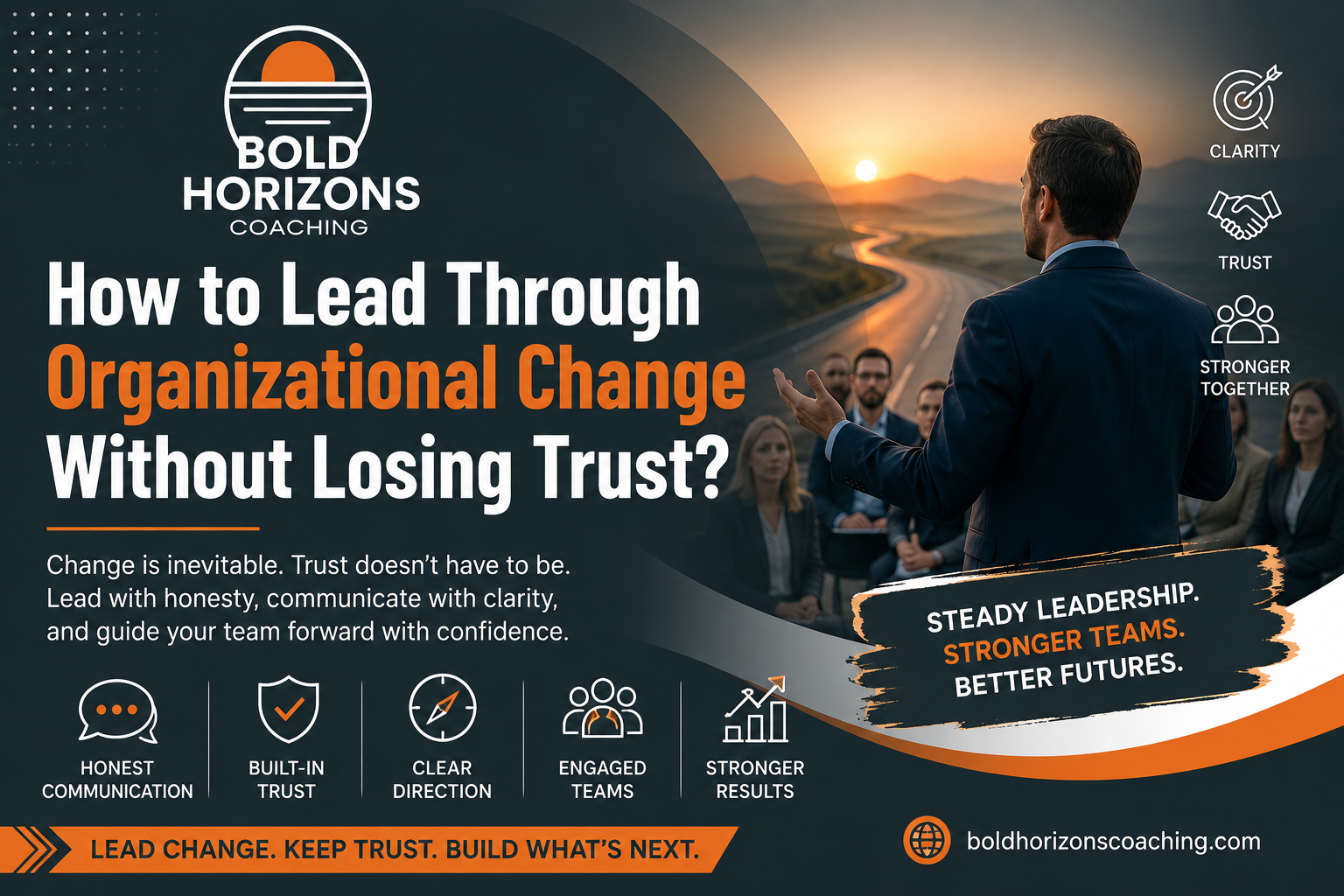
When David’s company announced a merger, he stood in front of his department and delivered the message he had been given: this would be good for everyone, nothing major would change, and business would continue as usual.
Three months later, half of it was already untrue. Roles shifted, a favorite manager left, and priorities were rewritten twice. David had not lied. He had simply repeated reassurance he could not actually guarantee, and his team noticed.
Change is one of the few certainties in modern organizational life, yet very few leaders receive real preparation for leading through it. What separates leaders who keep their team’s trust from those who lose it is rarely the change itself.
It is how honestly, consistently, and humanly they communicate while the ground is still moving.
Why Change Threatens Trust Faster Than Almost Anything Else?
Trust is built on predictability. Employees trust leaders whose words and actions align over time. Organizational change disrupts that predictability by definition, which is exactly why it puts trust at such high risk. When information is incomplete, employees fill the gaps with assumptions, and those assumptions are rarely generous.
Leaders often make the problem worse by overcorrecting toward certainty they do not actually have. Promising that nothing will change, or that everyone’s role is safe, feels comforting in the moment but becomes corrosive the first time it proves false. Once a leader’s words stop matching reality, every future message gets read with suspicion.
Say What You Know, What You Don’t, and What Comes Next
The leaders who navigate change well tend to follow a similar communication pattern, whether or not they have ever named it explicitly. They separate three categories clearly: what is confirmed, what is still undecided, and what the team can expect regarding timing of future updates. This structure does more to protect trust than any single reassuring phrase.
• State facts plainly, even when they are uncomfortable, rather than softening them into vague language
• Acknowledge open questions honestly instead of pretending they are already resolved
• Commit to a specific date or cadence for the next update, and keep that commitment
• Invite questions directly, even the ones leadership cannot fully answer yet
• Follow up individually with people whose roles are most affected, rather than relying only on group messages
This approach requires a leader to sit with some discomfort, since admitting uncertainty can feel like a loss of authority. In practice, the opposite tends to be true. Teams consistently report more confidence in leaders who are candid about ambiguity than in leaders who project false certainty.
The Coaching Conversation Behind Steady Change Leadership
Executive coaching plays a particular role during periods of organizational change because it gives leaders a private space to process their own uncertainty before they carry it into the room. David, working with a coach after the merger announcement, realized that much of his instinct to over-reassure his team came from his own anxiety about the changes, not from a genuine read of what his team needed to hear.
A coach helps a leader separate their personal reaction to change from their responsibility to communicate it well. This distinction matters enormously. Leaders who process their own fear or frustration privately, rather than unconsciously transmitting it in every meeting, give their teams a steadier presence to follow, even when the underlying situation remains genuinely unsettled.
Consistency matters more than eloquence here. A leader who delivers a modest update every Friday at the same time, without fail, will typically earn more trust over a quarter than a leader who delivers one brilliant all-hands speech and then goes quiet for weeks while decisions are finalized behind closed doors.
Rebuilding Trust When It Has Already Slipped
Not every leader gets the chance to communicate change well from the very first announcement. Sometimes trust has already eroded before a leader recognizes the pattern. Rebuilding it is possible, but it requires more than an apology.
It requires a visible, sustained change in behavior: following through on smaller commitments consistently, inviting feedback and acting on it, and being transparent about past missteps rather than glossing over them.
Employees do not expect leaders to have all the answers during a transition. They expect leaders to tell the truth about not having them yet, and to keep showing up with information as it becomes available.
That combination of honesty and consistency is what most reliably restores confidence. It also tends to happen faster than leaders assume, provided the change in behavior is genuine rather than performative.
The Bottom Line
Change will always create uncertainty, but it does not have to create distrust. The leaders who protect their team’s confidence are not the ones with the most polished announcements. They are the ones whose words and actions stay aligned, even when the situation is still unfolding.
David eventually rebuilt his team’s confidence, not with a single speech, but by replacing blanket reassurance with honest, regular updates his team could rely on. Within a year, this was the team other managers pointed to as the one that had come through the merger the strongest.
Bold Horizons Coaching partners with leaders navigating exactly this kind of transition. Through personalized executive leadership coaching, we help you find the clarity and steadiness your team needs, especially when the path ahead is still taking shape.
If your organization is facing change and you want to lead it without losing your team’s trust, we would welcome the conversation.