
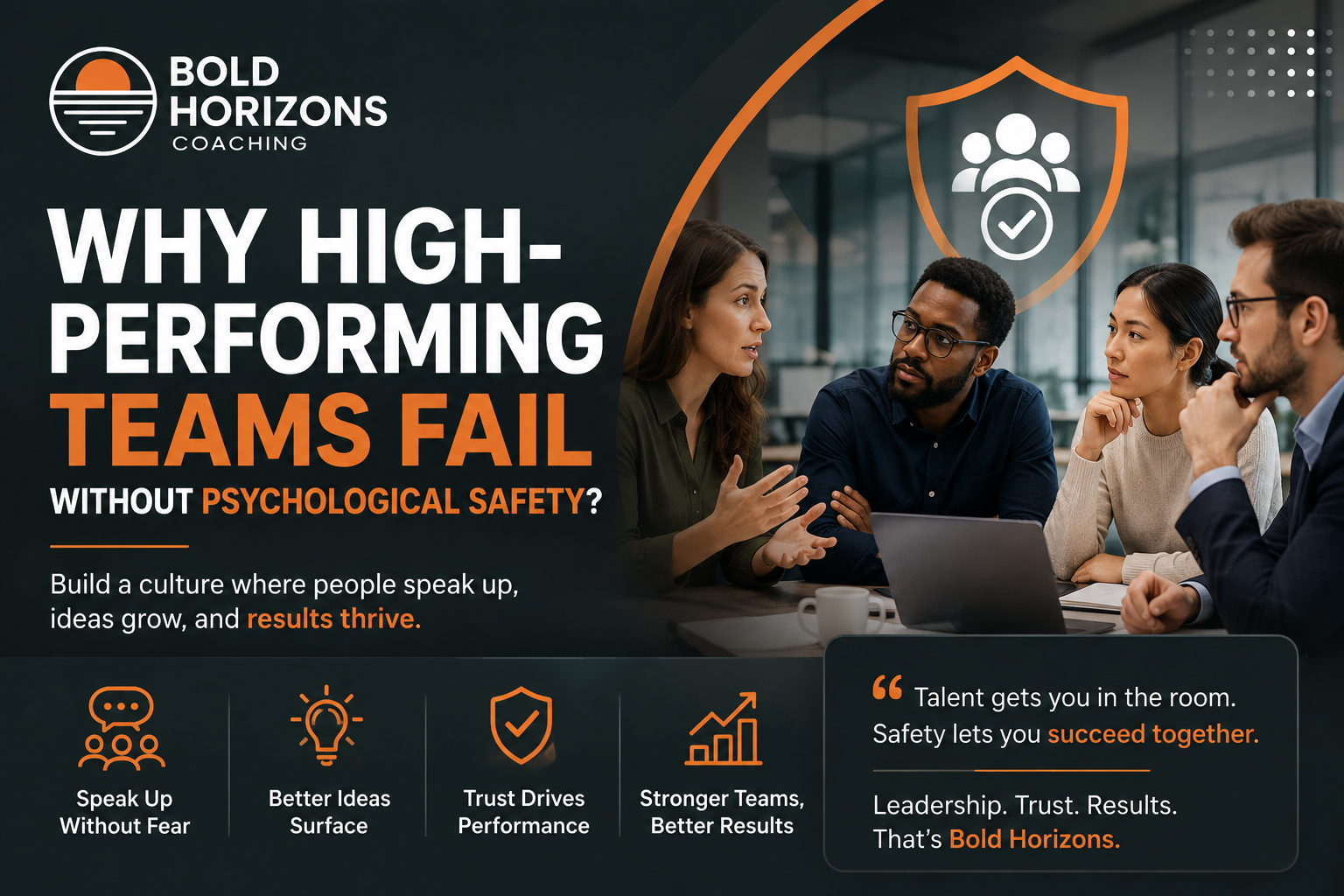
Maria led one of the most talented teams in her company. Every person on her roster had the resume to prove it: strong degrees, sharp instincts, a track record of hitting targets. Yet in her weekly meetings, something felt off.
People nodded along, agreed quickly, and left the room without ever raising the concern Maria knew they were carrying. Six months later, a product launch failed for a reason three people had privately predicted. Nobody had said it out loud.
Maria’s team did not have a talent problem. It had a safety problem. Psychological safety, the shared belief that a team is safe for interpersonal risk-taking, is one of the most researched and most overlooked ingredients in leadership performance.
Google’s own Project Aristotle studied hundreds of internal teams and found that psychological safety mattered more to team effectiveness than who was on the team at all. Skill without safety simply stays quiet.
What Psychological Safety Actually Looks Like?
Psychological safety is not the same as being nice, and it is not the absence of conflict. It is the confidence that speaking up, admitting a mistake, or challenging an idea will not damage how a person is seen or treated. Teams with high safety debate hard, disagree openly, and still trust one another afterward. Teams without it often look calm on the surface while problems quietly compound underneath.
The difference shows up in small, everyday moments: whether a junior employee will correct a senior leader’s math in a meeting, whether someone will admit they missed a deadline before it becomes a crisis, and whether a new idea gets a fair hearing or gets laughed off before it is finished.
The Cost of Silence in High-Performing Teams
Ironically, the most capable teams are often the most vulnerable to this failure. High performers are used to being right, and leaders of high performers can mistake competence for confidence. But even the strongest professionals stay quiet when they sense that candor carries a penalty. The result is a team that looks aligned in meetings and discovers misalignment in outcomes.
Consider how the presence or absence of psychological safety tends to shape everyday team behavior:
| Team Behavior | Low Psychological Safety | High Psychological Safety |
| Handling mistakes | Hidden or blamed on others | Disclosed early and addressed |
| Meeting dynamics | Quick agreement, little debate | Respectful challenge and questions |
| New ideas | Rarely offered by junior staff | Contributed across all levels |
| Feedback to leaders | Filtered or avoided | Direct and constructive |
| Response to setbacks | Defensiveness, finger-pointing | Shared problem-solving |
Why Leaders Unintentionally Suppress Safety?
Most leaders do not set out to create silence. It happens through small, repeated signals: reacting sharply to bad news, rewarding agreement over debate, or moving so fast that dissent feels like a delay rather than a contribution. Over time, employees learn the unwritten rule faster than they learn the stated values on the wall.
Research popularized by Harvard Business School’s Amy Edmondson has shown that teams with higher psychological safety report more errors, not because they make more mistakes, but because they feel safe naming them. Leaders who read low error counts as a sign of strength often have the story backward. Silence is frequently a symptom, not a success.
This is where executive coaching plays a distinct role. A coach helps a leader notice these patterns in real time, often patterns that are invisible from the inside. Leadership habits that feel efficient to the leader can feel intimidating to the team, and few people will volunteer that feedback without a structured, safe process for surfacing it.
Maria, once she began working with a coach, realized her habit of jumping straight to solutions in meetings was, without meaning to, signaling that concerns were problems to be solved quickly rather than issues worth exploring together.
Building Safety Without Lowering the Bar
Psychological safety and high standards are not opposites. In fact, the most effective teams combine both: clear expectations paired with genuine room to speak up. Leaders build this combination through consistent, practical habits rather than one-time announcements.
• Responding to bad news with curiosity instead of blame, so people keep bringing it forward
• Asking for dissenting views directly before finalizing decisions
• Acknowledging their own mistakes openly, which gives others permission to do the same
• Separating the discussion of ideas from the evaluation of the person who raised them
• Following up privately when someone stays unusually quiet in a meeting
These habits are simple to describe and genuinely difficult to sustain under pressure, especially for leaders who were promoted for decisiveness rather than openness. That is precisely why this shift is coached, not just taught.
The Bottom Line
A team can be full of talented people and still underperform if honesty carries a hidden cost. Psychological safety is what allows expertise to actually reach the table. Leaders who invest in building it do not lower their standards; they simply make sure their best thinking, and their earliest warnings, are heard before problems become expensive.
Maria’s team eventually rebuilt that trust, not through a single announcement, but through months of consistent, small moments where speaking up was met with genuine curiosity instead of correction. The next time a launch date approached, three people raised concerns two weeks early. The project shipped on time.
At Bold Horizons Coaching, we work with leaders and teams who want more than surface-level agreement. Through personalized executive leadership coaching and team workshops, we help you build the trust that lets your strongest people do their strongest work.
If your team’s meetings feel calmer than your results suggest they should be, it may be time for an honest conversation about what safety looks like in your organization.