Every January, millions of Americans set goals. By February, the gym is empty again. The vision board sits untouched. The word of the year? Nobody remembers it.
This is not a willpower problem. It is a design problem.
At Bold Horizon Coaching, we work with leaders who are extraordinarily disciplined and driven, and who still find themselves cycling through the same goals year after year without the results they know they’re capable of. If that sounds familiar, you’re in the right place.
Why Do Most Goals Fail?
Research shows that only about 8% of Americans achieve their New Year’s resolutions. But goal-setting itself is not the problem. The problem is how most goals are set: tied to outcomes without being anchored to identity, ambitious without structure, and set in isolation without any real accountability.
For leaders in particular, there is an added layer. Goals created in survival mode reactive, defensive, and focused on managing crises rather than creating possibilities rarely generate sustained momentum. You need goals that pull you forward, not ones you have to drag yourself toward.
The Bold Horizon Framework for Goals That Stick
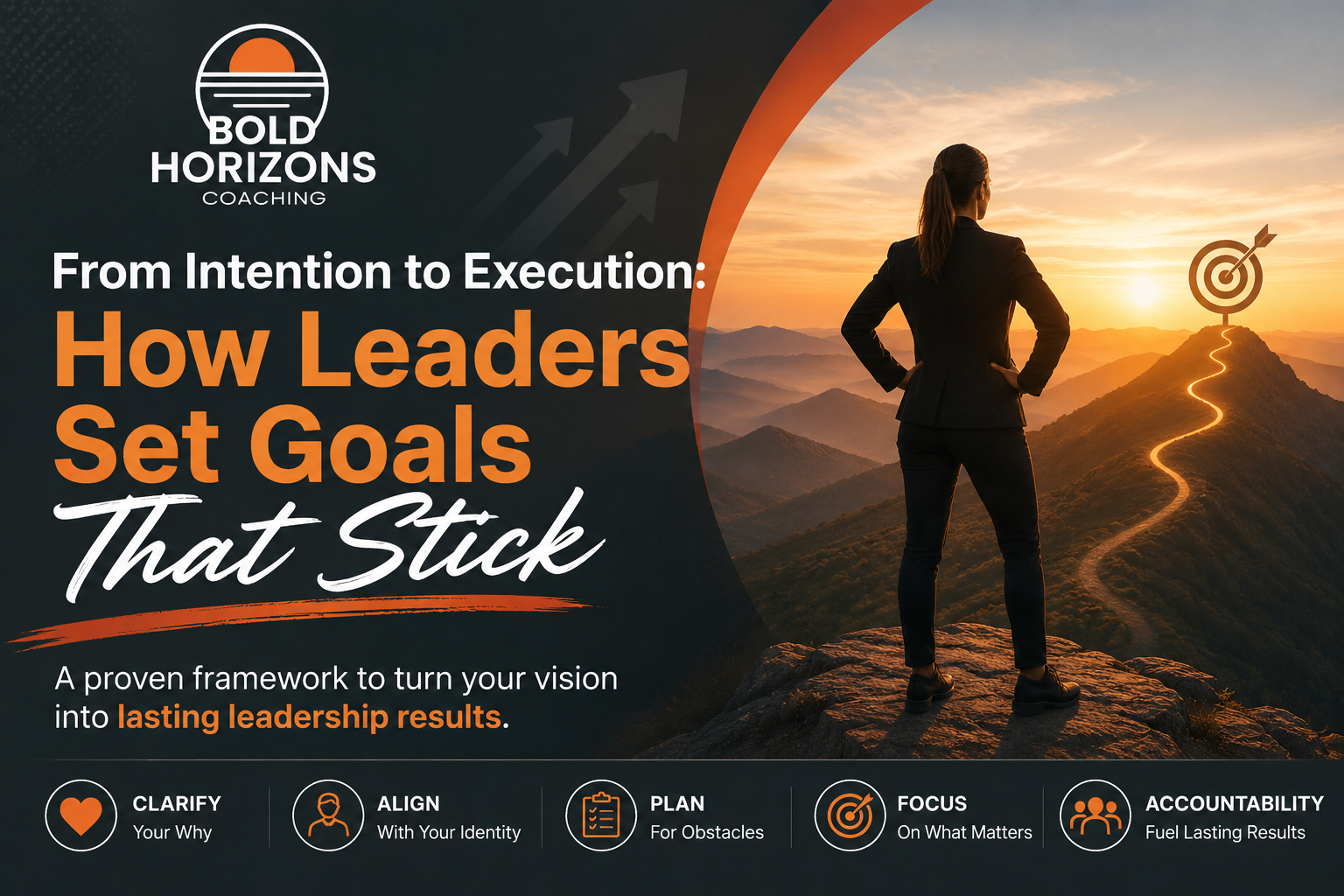
Step 1: Start with your why. Every goal needs a real anchor. Before you write down what you want to achieve, dig into why it matters, not the surface answer, but the real one. Goals connected to a deeply held value are sustained by intrinsic motivation, not willpower.
Step 2: Close the identity gap. Dr. Heidi Grant Halvorson’s research on the science of motivation, goal-setting and leadership, shows that the most durable goals are tied to who you are becoming, not just what you want to do. The shift from ‘I want to run a marathon’ to ‘I am someone who prioritizes my health’ is a game-changer.
Step 3: Plan for obstacles: Every meaningful goal will be tested. Build your plan with real life in mind: the missed week, the difficult quarter, the unexpected demands. The goal is not to avoid setbacks; it’s to know how you’ll keep going when they happen.
Step 4: Make it specific and time-bound. Vague goals produce vague results. ‘Get better at public speaking’ is not a goal. ‘Deliver three high-stakes presentations confidently by the end of Q3’ is a goal.
Step 5: Build in real accountability. This is the step most people skip, and the one that makes the biggest difference. Accountability is not about guilt. It’s about having someone in your corner who genuinely cares about your growth and will hold the vision steady when you can’t.
The Leader’s Goal-Setting Checklist
| Question to Ask Yourself | Why It Matters |
| Is this goal connected to a core value? | Values-driven goals sustain motivation over the long haul. |
| Does this reflect who I am becoming? | Identity alignment drives consistent behavior. |
| Is this specific and measurable? | Clarity creates the conditions for action. |
| Have I planned for obstacles? | Resilience is built in advance, not improvised. |
| Do I have an accountability structure? | External commitment accelerates follow-through significantly. |
| Is this goal energizing or just obligatory? | Anabolic, energizing goals fuel achievement. Draining ones don’t. |
| Have I written it down and shared it? | Studies show written goals are 42% more likely to be achieved. |
At Bold Horizon Coaching,
We build intentional growth plans with every client we work with. Not just goals, but complete systems of awareness, structure, and accountability designed for the specific life and leadership context of each person.
Your goals deserve more than a January resolution. Let’s build something that actually lasts. Reach out today to get started.