
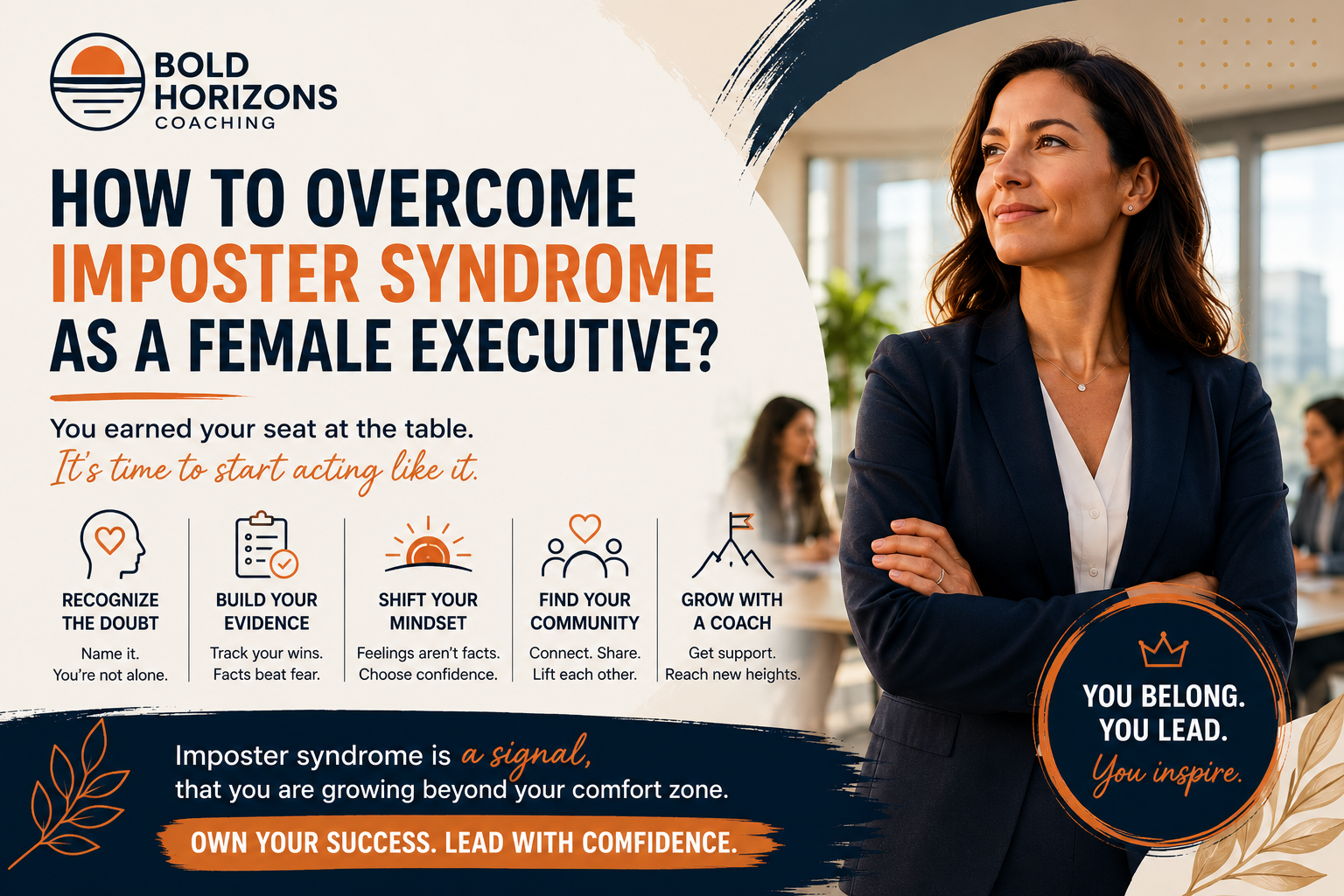
You earned your seat at the table. It’s time to start acting like it.
She had just been promoted to Vice President at a mid-size firm. Her team was celebrating, her inbox was flooded with congratulations, and yet, sitting in her new corner office on her first Monday morning, she kept waiting for someone to walk in and say it was all a mistake.
Sound familiar? If you have ever felt like a fraud despite real, undeniable accomplishments, you are not alone. A study found that 75% of executive women in the US reported experiencing imposter syndrome, and many said it got worse as they moved up the ladder.
At Bold Horizon Coaching, we work with high-achieving women leaders across the region who carry this invisible weight every single day. And we are here to tell you: it does not have to define your story.
What Exactly Is Imposter Syndrome?
Imposter syndrome is not a character flaw. It is not a sign that you do not belong. It is a deeply rooted psychological pattern where capable, accomplished individuals doubt their own abilities and live in fear of being ‘found out.’
For women in executive roles, imposter syndrome is often intensified by systemic challenges in corporate environments. Many have spent years navigating spaces that were not designed with them in mind. They may also carry the invisible emotional labor that keeps teams and organizations functioning, while being held to standards that seem to shift depending on who is evaluating them.
The result? A constant inner voice whispering: You don’t really belong here.
Why Does It Hit Harder in the Executive Suite?
The higher you climb, the more visible you become. And for many women leaders in the US, visibility feels like exposure. Each new title raises the stakes. The boardroom becomes a stage where every decision feels like it could reveal you as someone who doesn’t quite measure up.
There is also what researchers call the double bind: be too assertive and you’re labeled aggressive; be too collaborative and you’re seen as a pushover. This impossible balancing act fuels the belief that no matter what you do, you will fall short. It’s exhausting and it’s one of the leading reasons talented women in leadership pull back right when they’re on the edge of their greatest impact.
Five Strategies That Actually Work
At Bold Horizon Coaching, we guide our clients through a process that is as practical as it is transformational. Here is where to start:
1. Name it out loud. Imposter syndrome thrives in silence. The moment you name it, to yourself, a trusted colleague, or your coach, it loses some of its grip. You are not confessing a weakness. You are taking back your power.
2. Build your evidence file. Keep a running document of your wins, your measurable impact, and the feedback you’ve received. When the inner critic gets loud, open the file. Facts are a powerful antidote to self-doubt.
3. Separate feelings from facts. Feeling like a fraud is not the same as being one. This distinction sounds simple, but it is one of the most powerful cognitive shifts our clients make in coaching.
4. Find your community. Women who lead together lift each other up. Group coaching programs provide a safe space to voice your doubts without judgment, and discover that the accomplished woman sitting across from you feels exactly the same way.
5. Work with a coach. Executive coaching creates a confidential space to explore the roots of imposter syndrome and rewrite the internal narratives that are holding you back from the leader you are meant to be.
A Note From Bold Horizon Coaching
Imposter syndrome is not a life sentence. It is a signal, one that points directly to your next edge of growth. At Bold Horizon Coaching, we believe every woman already has what it takes to lead powerfully and brilliantly. Coaching helps you reconnect with that truth and operate from it every single day.
Ready to quiet the voice that says you don’t belong? Let’s talk.