When Elena proposed a coaching engagement for her leadership team, the first question from finance was predictable: what is the return? She had a genuine answer about confidence, clarity, and better conversations, but she also knew that a compelling personal experience would not be enough to secure the budget on its own. She needed to show what coaching actually changes, in terms the organization could measure.
This is one of the most common tensions in leadership development. Coaching produces real, often profound shifts in how a leader thinks and behaves, yet those shifts are frequently described only in emotional language: more confident, more self-aware, calmer under pressure. Those outcomes matter, but they are not the whole story, and they are rarely enough to justify continued investment on their own.
Why Coaching ROI Is Harder to Measure Than Training ROI
A training session teaches a specific skill and can be measured against a specific outcome. Coaching works differently. It changes how a leader approaches decisions, conversations, and pressure across dozens of situations that were never explicitly discussed in a session. That breadth is coaching’s strength and also the reason its ROI is harder to isolate.
The solution is not to abandon measurement. It is to measure the right things, at the right level, over the right time horizon. Leadership growth shows up in behavior first, then in team outcomes, and only later in the broader business metrics that finance ultimately cares about.
A Framework for Measuring Coaching Impact
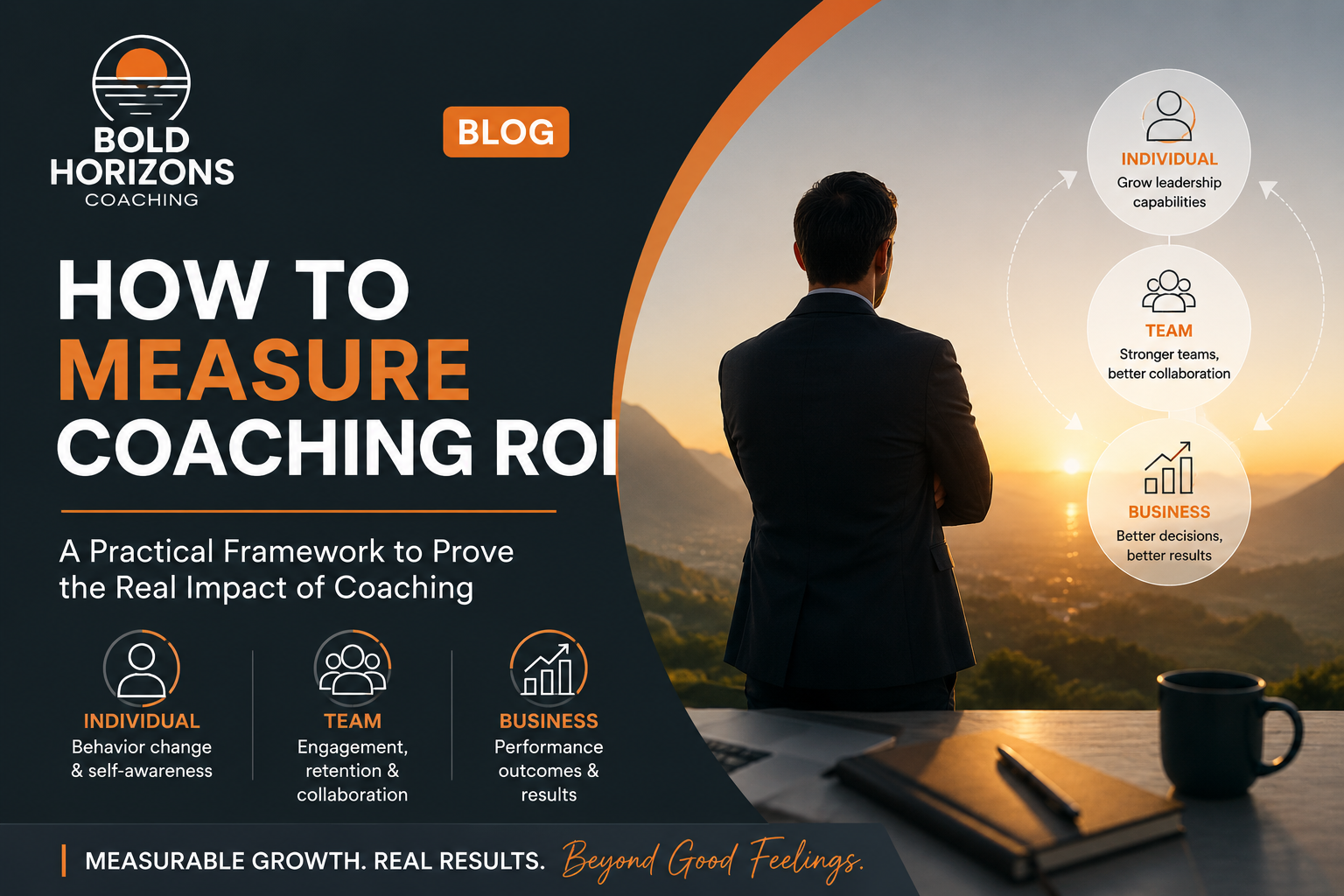
Organizations that measure coaching well typically track indicators across three tiers, moving from the individual leader outward to the business:
| Level | What to Measure | Example Indicator |
| Individual | Behavior change and self-awareness | 360 assessment scores before and after coaching |
| Team | Engagement, retention, and collaboration | Team engagement survey results, voluntary turnover |
| Business | Performance outcomes tied to leadership decisions | Project delivery timelines, goal attainment rates |
Individual-Level Indicators
At the individual level, structured assessments taken before and after a coaching engagement provide a concrete baseline. Tools such as 360-degree feedback or energy-based leadership assessments capture how a leader is perceived across categories like communication, decisiveness, and emotional regulation. Comparing results over a six to twelve month engagement gives both the leader and the organization a measurable picture of change, rather than a general impression.
Elena’s team used an assessment at the start of their engagement and again after nine months. The comparison showed measurable movement in delegation and conflict navigation, two areas that had shown up repeatedly in employee feedback before coaching began.
Team-Level Indicators
Leadership growth rarely stays contained to the leader alone. It shows up in how their team functions. Rising engagement scores, declining voluntary turnover, and improved internal survey results around trust and communication are all reasonable proxies for leadership development, particularly when tracked for the same team over a consistent period.
• Employee engagement survey trends for the coached leader’s team specifically
• Voluntary turnover within the team, compared to the organization’s broader average
• Internal feedback on manager effectiveness, gathered through regular pulse surveys
Business-Level Indicators
The most convincing ROI conversations connect leadership behavior to outcomes the business already tracks: project timelines, goal attainment, client retention, or the speed of decision-making on cross-functional initiatives. These connections are not always perfectly clean, since many factors influence business results, but consistent improvement following a coaching engagement, especially alongside individual and team-level gains, builds a credible case.
Research from organizations such as the International Coaching Federation has repeatedly found that companies report meaningful returns from coaching investment when it is paired with clear goals and consistent follow-through, rather than treated as a one-time event.
Why the Feelings Still Matter
None of this means the qualitative side of coaching should be dismissed. Confidence, clarity, and reduced stress are real outcomes that deserve to be named, and they often precede the measurable changes that show up later in surveys and business metrics. The goal is not to replace the personal story with a spreadsheet. It is to pair both, so that coaching’s value is visible to the leader experiencing it and defensible to the organization funding it.
The Bottom Line
Coaching ROI is real, measurable, and worth tracking deliberately rather than assumed on faith. Leaders and organizations who define clear indicators at the start of an engagement, across individual, team, and business levels, consistently make a stronger case for continued investment, and gain a clearer picture of what is actually changing.
Elena’s proposal moved forward once she paired the human story with a measurement plan finance could stand behind. A year later, the same leadership team’s engagement scores and retention numbers made the renewal conversation considerably shorter.
Bold Horizons Coaching works with individuals and organizations to design coaching engagements with clear, trackable goals from day one. If you want leadership development that shows results beyond good feelings, we would be glad to help you build a measurement plan alongside the coaching itself.